
Corporate publishing is no longer a side project. Communications teams continuously produce content for websites, newsletters, social media, internal channels, and campaigns. The challenge for many teams is maintaining oversight. Topics run in parallel, content gets duplicated, and coordination takes time.
Successful corporate publishing is therefore no longer defined by individual formats, but by how well content is planned, coordinated, and published. How is corporate communication organized? Teams that create structure gain efficiency, consistency, and impact across all channels.
Content of this page
What does corporate publishing mean today?
Today, corporate publishing refers to the strategic planning, production, and distribution of content across a company’s owned channels. The goal is to manage topics in a structured way, organize content efficiently through editorial planning, and ensure consistent communication across channels. Responsibility may lie with a single team or be shared across departments, from PR to marketing. That’s why centralized content planning across departments has become a best practice in corporate publishing.
In contrast to the traditional understanding – which focused heavily on individual media formats, such as a single corporate publication or customer magazine – today the emphasis is on organizational and process-driven management. Topic planning, editorial workflows, and publishing come together in one integrated system.
Corporate content is growing — and so is the complexity
Companies publish more content than ever before. New channels emerge, audiences become more segmented, and expectations around timeliness and quality continue to rise. At the same time, resources remain limited and teams lose oversight: who is working on which topic? What has already been published? Which content can be reused?
This often leads to a familiar pattern: content is produced, but without clear prioritization. Topics compete with one another, publications feel uncoordinated, and existing content is rarely reused. Publishing turns into a constant operational task instead of a strategic lever for corporate communication.
Typical challenges in everyday corporate publishing
In practice, the real difficulties rarely lie in generating ideas, but in execution. Communications teams are familiar with situations like these:
- Topics are worked on in parallel without central alignment
- Content is created for individual channels instead of across channels
- Editorial plans exist as isolated lists
- Approval processes delay publication
- Content already exists, but is scattered across tools, folders, or inboxes and is hard to find or reuse
These problems don’t stem from a lack of expertise, but from missing structure in corporate communication.
How modern corporate publishing works
Modern content work follows four clear principles that have proven effective in practice.
Topics take center stage, not channels
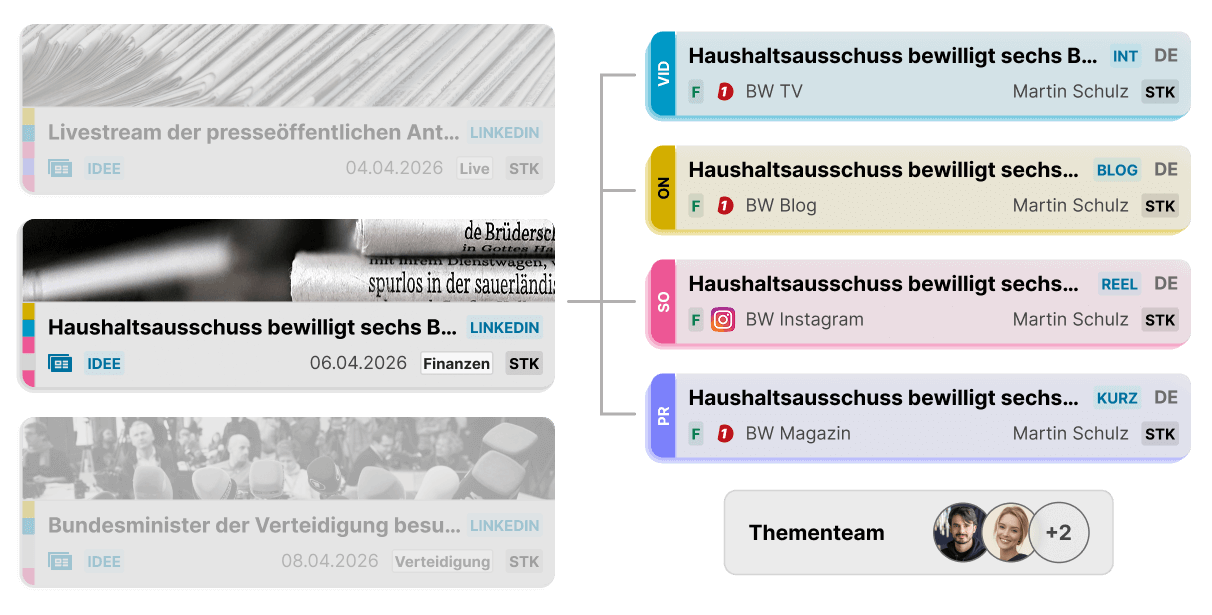
Instead of planning separately for each channel, teams define stories that can be developed across multiple formats and platforms in a cross-media way.
Content is planned centrally
All topics, statuses, responsibilities, and timelines are visible in one place – ideally within a digital editorial system. This creates transparency and reliability.
Content is created in modular building blocks
One topic leads to multiple stories and formats. It can be used as an article, social post, newsletter module, or video — without starting from scratch each time.
Publishing is part of the workflow
Publication is not the final step; it is considered from the very beginning. The result is a proven, integrated process that spans from planning to analysis.
The corporate newsroom as the organizational backbone
A corporate newsroom as a central communications hub can help organizations manage the challenges of modern corporate communication. In this context, the term newsroom refers to a concept for centrally bundling all communication activities. Some companies also implement it as a physical space equipped with the necessary technology.
Above all, a corporate newsroom provides the structural foundation for modern corporate publishing. It brings together topics, content, and stakeholders within a shared working logic. The goal is to break down silos between marketing, communications, PR, and HR and to manage topics collaboratively. The focus is on transparency, prioritization, and alignment – regardless of whether the newsroom is organized physically or virtually.
Which software for corporate publishing matters
As the number of topics grows, channels multiply, and stakeholders increase, spreadsheets, standalone tools, and email coordination quickly reach their limits. Daily work becomes complex and hard to manage. Content planning software like Newsmind Stories provides clarity by bringing planning, creation, coordination, and publishing together in one central system. But the real value goes beyond that. It supports communications teams in handling both their operational tasks and their strategic responsibilities more effectively.
Typical tasks where an editorial system like Newsmind Stories makes a difference:
Software for a corporate newsroom doesn’t replace strategy. But it makes corporate publishing manageable and transparent. And in complex organizations, that’s the key difference between reactive content production and truly orchestrated corporate communication.
Corporate publishing in practice: an example
One practical example is the German Bundeswehr’s communications team. They use the web-based editorial management system Newsmind Stories to structure their workflows efficiently — across a wide range of channels and formats, including:
- the website bundeswehr.de,
- their magazine „Y“,
- the internal communication platform „YNSIDE“,
- social media channels like YouTube and Instagram
- as well as podcasts.
Around 150 employees in Berlin run daily editorial meetings, plan publications, coordinate subject-matter reviews, and distribute content across different platforms. With the introduction of Newsmind Stories, planning, content creation, approval, and publishing are brought together in one central digital workspace. Topics, responsibilities, and status updates are fully transparent and easy to track.
Want to know more?
Modern corporate publishing — our conclusion
Today, corporate publishing determines whether corporate communication creates impact or fades away. Teams that plan topics centrally, manage content systematically, and think publishing as an integrated process create clarity, efficiency, and consistency. Cross-team collaboration in a newsroom setting supports this approach, and using a powerful newsroom solution like Newsmind Stories provides the structure needed to make it work.

More interesting articles that you shouldn’t miss