
The corporate newsroom is a response to today’s communication reality: content has to be published consistently, quickly, and in a coordinated way across many channels. Originally developed in journalism, the concept has become firmly established in corporate communications as a structure that brings together topics, teams, and processes.
On this page, you’ll learn how modern organizations shape their newsroom, which foundations really matter, and how AI helps manage topics more intelligently. With practical examples, we show how large communications teams coordinate content, create structure, and strengthen their communication planning for the long term.
Contents of this page
What is a corporate newsroom – and what does it mean for large communications teams?
A corporate newsroom is the central hub for managing communication within an organization. Instead of working separately by department or channel, teams from PR, marketing, internal communications, HR, investor relations, and other areas bring their topics together in one shared system. The content idea comes first – the adaptation to formats and channels follows afterward.
Especially in large organizations, this model helps reduce complexity and manage communication more strategically. When everyone plans in the same place, messaging becomes more consistent, coordination gets faster, and processes become easier to follow.
A newsroom creates the foundation for integrated communication — with clear responsibilities, shared goals, and transparent topic management. It enables teams to plan and prioritize their content across channels while staying flexible.
What are the key characteristics of a newsroom for corporate communication?
In a corporate newsroom, topic management is at the center. This means:
- Teams define which topics are relevant for the organization and prioritize them based on strategic importance.
- Responsibilities and roles are clearly defined, for example with a duty editor or editor in chief who coordinates topics across all teams.
- Instead of maintaining countless spreadsheets or parallel tools, everyone works in one shared editorial system. This gives teams a clear view of who is working on what, when something will be published, and which content can be reused.
- This level of transparency makes it easier to share content across departments, streamline approvals, and increase the overall efficiency of communication.
A well-structured corporate newsroom is more than an organizational model — it’s the key to consistent, predictable, and measurable communication across all channels.
Reading tip: how do you plan topics from the initial idea to publication in a structured way? Continue here: content planning in corporate communication
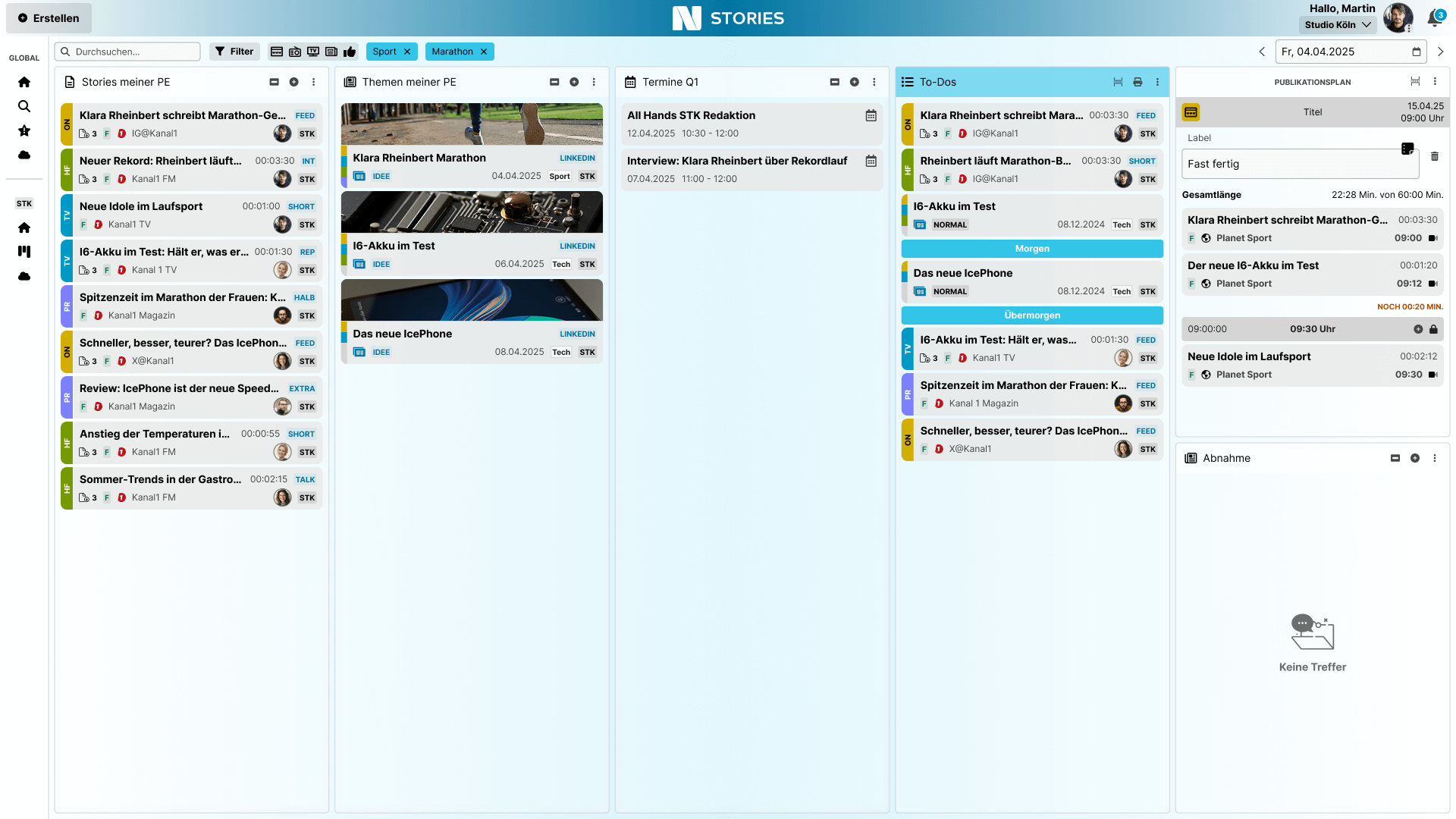
How the corporate newsroom works in practice
A corporate newsroom isn’t a rigid model but an organizational principle that adapts to the structures and needs of any company. What matters isn’t the name, but how topics, roles, and processes are connected.
Whether it’s called a news desk, topic desk, media desk, or content factory, the core idea is the same: communication becomes story-centric, connected, and strategically manageable. In practice, this can take very different forms — from physically centralized teams to fully decentralized newsrooms built on digital planning tools. In some organizations, the newsroom team really does sit together in one space. That’s where topics, ideas, and coordination come together. In daily or weekly editorial meetings, teams prioritize topics, assign responsibilities, and plan publications. Other organizations run their newsroom entirely virtually — using cloud-based planning systems, Kanban boards, or integrated AI tools that consolidate topic suggestions and data feeds.
Bundeswehr (Germany’s armed forces): The Bundeswehr’s communications team is streamlining its processes by bringing planning, development, approval, publishing, and evaluation together in one digital workspace. To do this, they rely on the editorial system Newsmind Stories. The result: 150 staff members in Berlin successfully manage content for a wide range of formats — from the website and magazines to social media and podcasts. With centralized planning and approval in a single system, their cross-channel work becomes more transparent and more efficient.
Deutsche Bank: a central communications team of around 30 people collects and coordinates topics from all business areas on a daily basis. Editorial meetings run much like in a journalistic newsroom: reporter-like roles research directly at the source, internal and external communication are closely connected, and content is distributed centrally through an in-house planning tool and the intranet. In addition, there are specialized teams that proactively drive topics (“offensive”) or respond to issues and crises (“defensive”).
Telekom: instead of a classic news desk, the model here is called the Content Factory. The name reflects its purpose — getting things done and putting integrated communication into practice. Topics move through a clear process chain, from strategy to content production and on to evaluation. This creates a 360-degree view across all topics, formats, and channels.
Deutsche Bahn: with the Content Network, the company is building a digital ecosystem that brings together different channels, brands, and collaborations. At its core is a content hub that consolidates content both editorially and technically while being fully integrated into the company’s digital infrastructure. This network makes it possible to distribute formats flexibly, develop new partnerships, and measure impact through data-driven topic management.
These examples make one thing clear: there is no single definition of a corporate newsroom. Some organizations work centrally and in the same physical space, others operate in a decentralized, fully digital setup. Some rely on classic desk structures, others call it a content hub or content factory. What matters is the shared logic: topics before channels, clear responsibilities, and transparent processes. That’s how strategy and content come together.
For a corporate newsroom to work in the long run, good intentions aren’t enough. It needs to be anchored organizationally, supported by the right technology, and embraced culturally. The next chapter outlines the key conditions that make this possible.
Requirements for an effective corporate newsroom
A corporate newsroom doesn’t just change workflows, it also reshapes collaboration and mindset. For the model to work, structures, processes, technology, and culture need to reinforce one another. The following four areas show what really matters:
Structure & Collaboration
A newsroom brings together different communication disciplines — PR, marketing, internal communications, HR, and investor relations. For this collaboration to work, teams need clear roles, defined responsibilities, and a shared framework for content planning. A steady rhythm is essential: regular editorial meetings, transparent decision-making, and a shared topic overview ensure everyone stays aligned. Whether teams sit in the same room or collaborate virtually through digital tools, the key is that topics and responsibilities are centrally visible and manageable.
Topics & processes
At the core is one principle: topics before channels. Every communications unit needs clarity on which strategic themes shape the organization – and how they are prioritized. Only then should formats, channels, and timing follow. A standardized topic process helps create structure: from idea generation to evaluation, approval, production, publication, and performance measurement. This creates a shared storyline across all channels, whether the final output is a press release, a social media post, or an internal update.
Technology & Tools
A newsroom relies on transparency and speed — and both are only possible with the right technological foundation. Modern editorial and planning systems bring together topics, timelines, and responsibilities in one central tool. They make it easier to reuse content, manage approvals efficiently, and plan based on data. Artificial intelligence is playing an increasingly important role as well, whether in monitoring, topic research, or automated content preparation.
What matters most is that technology isn’t an end in itself, but genuinely supports the editorial process – from the initial idea to publication.
Culture & impact
A successful newsroom thrives on mindset, not hierarchy. Many organizations are deliberately moving away from traditional line structures and shifting toward project-oriented collaboration. This allows teams to be assembled flexibly around topics, formats, or target groups. This way of working creates room for agility: people from different departments contribute to the same pool, resources are reassigned depending on the project, and reach and resonance show whether topics are landing. It enables short paths, quick decisions, and greater ownership. In this model, leadership is primarily about moderation, prioritization, and creating shared direction.
How AI changes workflows in corporate newsrooms
Artificial intelligence is already a natural part of editorial work. In a corporate newsroom, it helps teams identify topics faster, create content with more precision, and coordinate complex workflows. The goal isn’t to replace editors but to support them with data-driven insights, automated routines, and intelligent processes.
1. Identifying and prioritizing topics: In the pace of daily news, it’s crucial to spot early which topics could become relevant for your organization. AI-supported systems scan data streams, news feeds, and social media channels, detect trends, and rank them by relevance. This helps teams identify developments early, before they gain broader attention. Instead of reacting, teams can position themselves proactively.
2. Creating and optimizing content efficiently: AI supports writing, translation, tagging, and versioning. It can suggest suitable headlines, keywords, and formats, increasing consistency and strengthening SEO. In a corporate newsroom, this means less copy-and-paste work and more time for creative and strategic tasks.
3. Simplifying planning and coordination: Large communications departments often manage many parallel topics each day. AI can help coordinate deadlines, approvals, and production steps intelligently, and automatically flag dependencies or bottlenecks. Integrated systems like Newsmind Stories make these workflows transparent, highlight duplicated topics, and enable teams to manage themes, channels, and assets more efficiently.
4. Measuring impact and learning: A newsroom depends on understanding what works. AI-based analytics reveal which topics generate reach, which channels drive engagement, and where content needs refinement. This creates continuous learning loops that inform future decisions based on data rather than gut feeling.

AI isn’t a trend: it’s the next logical step for integrated corporate communication. It makes it easier to connect strategy, planning, and production into one continuous process and helps content teams work faster, more precisely, and more collaboratively. In a corporate newsroom, it becomes a key driver of efficiency and quality.
WANT TO LEARN MORE ABOUT NEWSMIND STORIES?
Talk to us about your ideas and requirements free of charge and without obligation. Let’s discuss your business case together and show you our solutions at first hand.

Sophie Kontz
Sales & Business
Development Manager
Benefits of a corporate newsroom for communications teams
A corporate newsroom is more than a new organizational model. It’s an engine for efficient, modern communication. It creates clarity, speeds up processes, and makes it possible to manage topics strategically across all channels. For large communications teams, this means:
Checklist: successfully introducing a newsroom in your organization
A corporate newsroom doesn’t just change processes: it transforms the entire way a communications department works. The following steps help guide that transition, from the initial idea to operational implementation.
Conclusion: the newsroom in corporate communication
A corporate newsroom isn’t an end in itself, but a structured response to the growing complexity of modern communication. It brings together topics, processes, and responsibilities and creates a shared foundation for strategic, coordinated work.
What matters most is managing topics transparently, producing content efficiently, and communicating messages consistently. A strong technological infrastructure is essential. Digital editorial systems like Newsmind Stories help teams bring planning, production, and distribution together in one place. They create transparency, simplify coordination, and make complex communication workflows manageable.
Anyone who sees communication as a strategic function needs a solid foundation — and a corporate newsroom concept that connects structures, people, and technology in a smart way.

More interesting articles that you shouldn’t miss