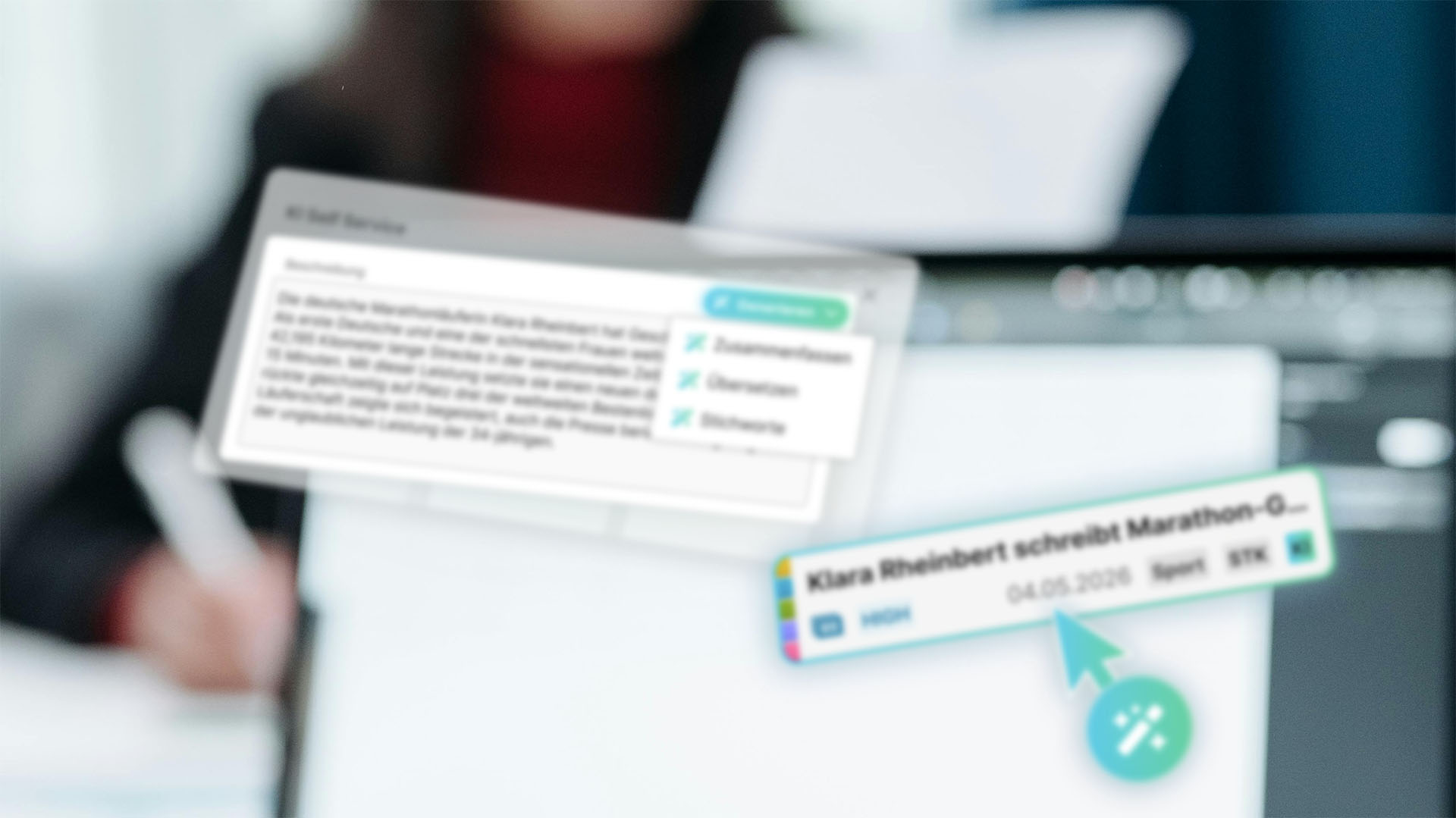
The focus in newsrooms and communications departments is currently shifting: It’s no longer just about whether AI can write text, but how it—as an AI assistant or AI agent—helps teams manage the daily flood of tasks and information. After all, anyone managing content across multiple channels today needs not just a chatbot, but an integrated strategy for AI-supported editorial processes. But what does practical collaboration between humans and machines look like in day-to-day editorial work? Are AI assistants and AI agents a solution for content creation and corporate communications?
What is an AI assistant?
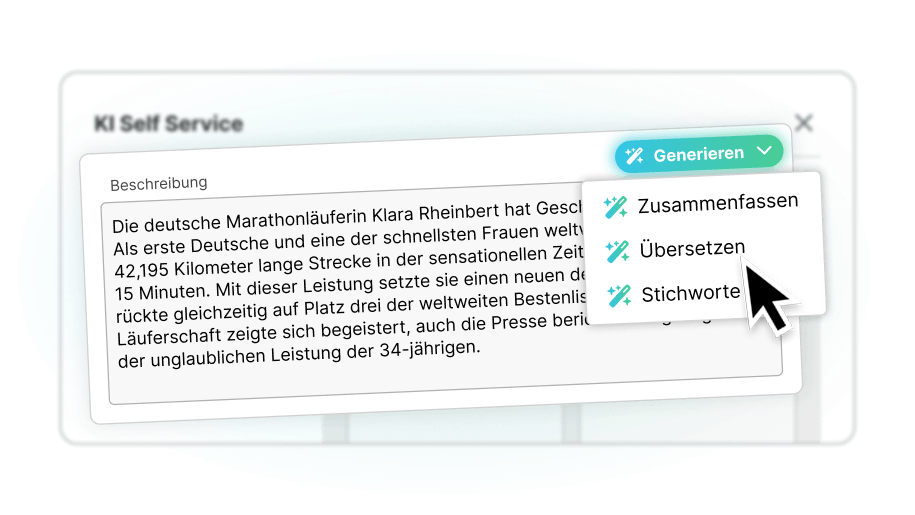
An AI assistant for editorial teams serves as a digital tool that performs specific tasks based on direct instructions, such as prompts, and intervenes in the process in a targeted manner. While humans oversee the process, the assistant handles routine tasks or time-consuming details, such as summarizing texts or rewriting them for a different format.
The tasks performed by an AI assistant are reactive in nature, meaning they are triggered by a click or a request in a chat with the AI:
- Content adaptation: Creates variations of a source text for different channels.
- Summary: Extracts key points from long documents or meeting minutes.
- Style & Tone: Optimizes text for a specific target audience or corrects grammar.
AI Assistants in Newsmind Stories: seamless integration Instead of a proliferation of tools
In Newsmind Stories, the AI assistant isn’t an external window or a separate chatbot. It’s an integral part of the editorial workflow and provides support right where the content is created.
What is an AI agent?
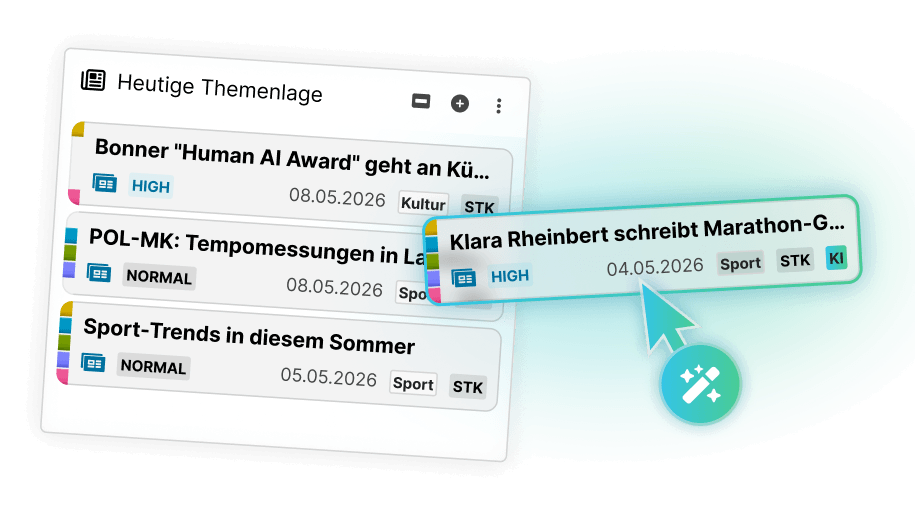
While an assistant waits for instructions, an AI agent works largely autonomously and goal-oriented in the background. It is not merely a tool, but plays a permanent role within the team. You can think of an agent as a digital colleague to whom you assign a specific area of responsibility—such as continuously monitoring sources or pre-structuring breaking news stories.
An AI agent is characterized by three features:
- Proactivity: It scans data streams on its own, without requiring a manual command each time.
- Contextual understanding: He “knows” which topics are relevant to the editorial team and filters out the noise.
- Results-oriented: He doesn’t just provide random links; instead, he organizes the information so that it can be used immediately.
AI agents in Newsmind Stories: a digital editorial colleague
In Newsmind Stories, we bring this technology to the operational level of a newsroom. AI agents are directly integrated into the planning system and can proactively assist in various roles—depending on how they are configured. This means that an AI agent in Newsmind Stories can essentially do everything a user can do in the editorial system. Here are some examples of the roles an AI agent can take on in Newsmind Stories:
The research agent
It scans connected sources (web links, RSS feeds, news agency reports) and automatically creates topic clusters. Instead of sifting through hundreds of individual reports, managers can immediately see relevant trends and “breaking news” in the dashboard.
The topic agent
It provides automated topic suggestions. Once configured, it not only finds information but also actively creates topics within the system. This ensures that editorial meetings never start from scratch. What makes it special is that the AI agent automatically updates the data whenever something about the topic changes (e.g., figures). This means users always have the most up-to-date information when they review the topic and plan a publication.
As a literary agent
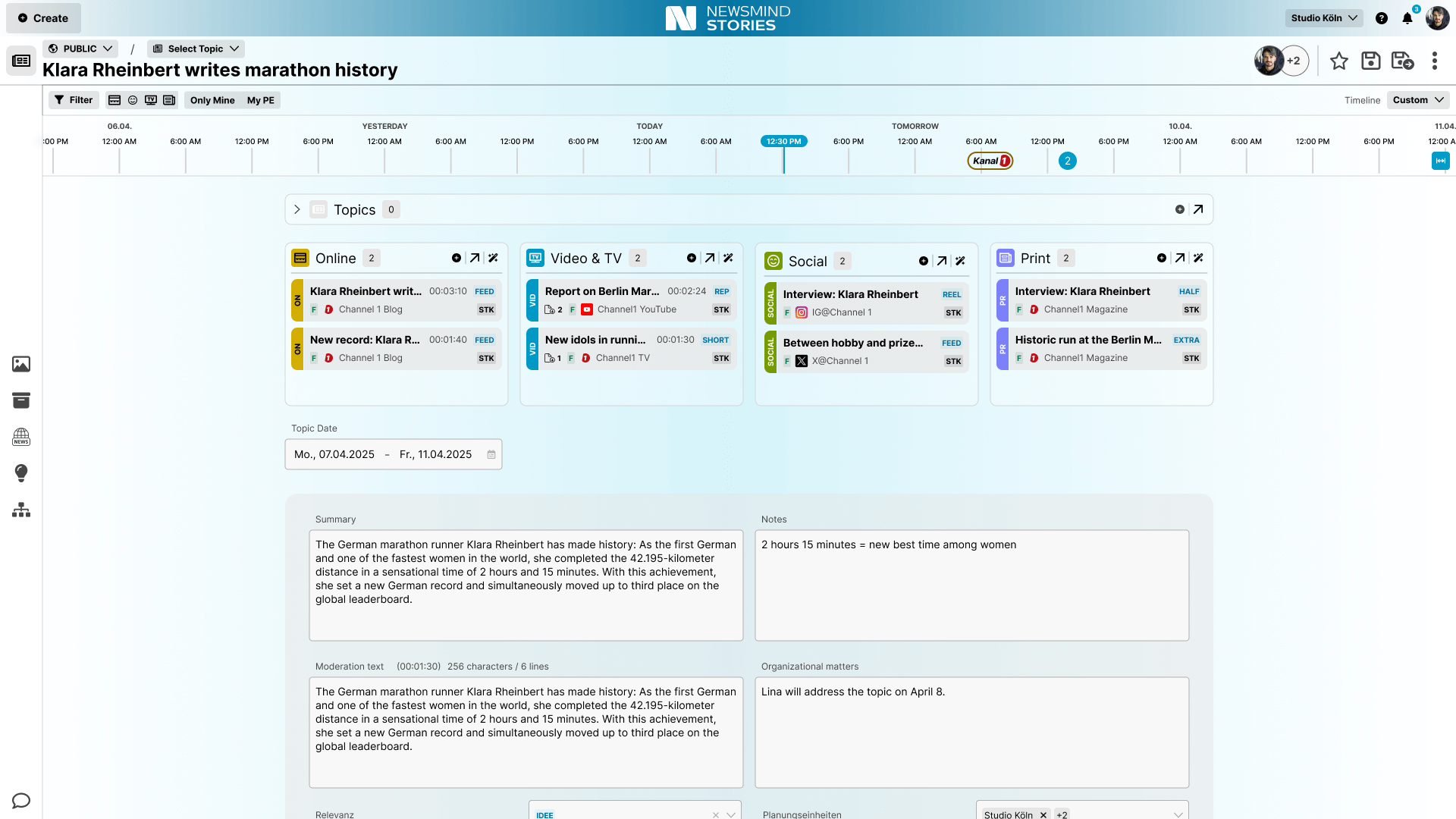
Drafts for stories and formats can already be prepared in advance. Such an agent can independently prepare summaries and notes to flesh out a topic or provide suggestions for social media. The editorial team can then take over the drafts and continue working on them.
The data agent
Whether it’s missing metadata, images, or stories that haven’t yet been assigned to a topic, AI agents can be configured in Newsmind Stories to automatically fill these gaps—for example, by finding and attaching images from a linked image database, filling in metadata on their own, or automatically linking stories to the appropriate topic.
The result: AI handles tasks such as time-consuming preliminary research and structuring, allowing the editorial team to focus entirely on organizing and finalizing the content.
In a nutshell: What’s the difference between an agent and an assistant?
AI assistant
Help inactive users with tasks
KI-Agent
Perform tasks independently and proactively
AI agents in action: 5 real-world scenarios for newsrooms
For AI agents and assistants to perform their tasks effectively, they should not be isolated tools but rather deeply integrated into daily workflows. The following scenarios illustrate what is possible in practice:
Would you like to see how Newsmind Stories can help you streamline routine tasks
and integrate seamlessly into your workflows?
Sign up for a free demo, and we’ll walk you through all of its AI features—from trend research to text drafting—during an online call.
Benefits of AI agents and assistants
The benefits vary depending on the configured agent and task, but the goal in Newsmind Stories remains the same:
- Save time
- Work more efficiently through integration
- Delegate routine tasks
Ultimately, integrating AI into Newsmind Stories isn’t about replacing people, but about taking the pressure off them. When AI agents handle the preliminary research and assistants speed up distribution, your team regains the time needed to create high-quality content that involves in-depth research and proper context. The AI lays the groundwork, while the creativity and quality come from you.
Reading tip: “Agentic AI is on the management agenda, but is still in its infancy”
The fact that AI agents are not just a trend but the next necessary step in development is also demonstrated by the recent study “Agentic AI in Marketing – Moving Fast, Staying in Control” by OWM and Accenture Song. More than half of the respondents expect AI to take over a significant portion of routine operational tasks in the future. And for just under 23 percent of the companies surveyed, agentic AI is already among their top three strategic priorities.
This is exactly where Newsmind Stories comes in: We provide newsrooms with the tools they need to integrate Agentic AI into their daily workflows in a safe and controlled manner.
Security and privacy: your ideas belong to you
Innovation in communication must never come at the expense of data security. Especially in editorial offices and corporate newsrooms, protecting exclusive information and strategies is of the utmost importance. That’s why security isn’t just an add-on in Newsmind Stories—it’s the foundation.
- Hosting in Europe: All cloud services are operated in compliance with the GDPR in Google Cloud or AWS data centers located within Europe.
- No training with your data: Your stories, texts, and ideas are not used to train public AI models. What you plan and write in Newsmind Stories stays within your secure system.
- Freedom of choice (Bring Your Own Model): You decide which AI model you want to use. Newsmind Stories gives you the flexibility to choose the right model or even integrate your own AI infrastructure.
- Full control through AI self-service: Through the admin panel, you can precisely control who is allowed to use which AI features at which stage of the workflow. This ensures you always retain full control over how the technology is used.